
 How to resolve AdBlock issue?


School board candidates speak at Chamber's Candidate Forum


- Details
- Tuesday, 20 October 2026
- Written by Aly Hansen
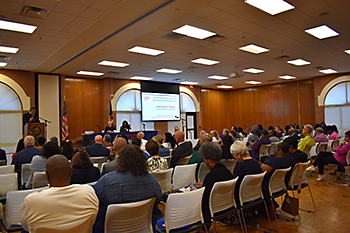
Fourteen of the sixteen candidates running for Cumberland County School Board of Education were present at the Greater Fayetteville Chamber’s Candidate Forum on Oct. 13 at Fayetteville Technical Community College. The candidates are vying for three open seats on the board.
Candidates were broken up into four groups of three and four participants each, and asked two randomly drawn questions a piece about various topics concerning Cumberland County Schools, students, educators and parents. Each candidate had one minute and thirty seconds to answer each of their two questions, and then the group as a whole was asked a “yes” or “no” question at the end of their time. No rebuttals were allowed. The question and answer session provided a platform for the candidates to talk directly to the community.
Group one consisted of Johnathaun Lee, Broxy Pone and Carol Stubbs. Theodore Lee Miller was assigned to this group, but did not make the forum.
Lee answered questions pertaining to retaining educators and making decisions about closing schools.
The board has guidelines regarding school closures, he said. But it goes further than that.
“Is it good for the community, is it good for the students?” he said.
Lee suggested hiring more educators with a specific teaching degree versus what he called “occupation teachers.” Educators who get degrees in teaching know how to handle classrooms, as that is what they are taught to do, he said.
Broxy Pone’s questions revolved around school choice and protecting projects from budget cuts.
“If it’s [school choice] not in every area, it’s not meeting every child's needs,” she said. “Every school should have a choice school and if you can’t put it in every district, there should be one centralized school for all the choices. All schools should be choice schools.”
Pone also suggested reaching out for additional sources of funding, and not just staying within Cumberland County to raise money for the school system.
“Everyone should invest in the child because the child creates the community,” she said.
Carol Stubbs’ questions were regarding access to bilingual teachers and school safety. Stubbs suggested reaching out to universities and colleges in the area and finding bilingual teachers among those populations.
As for school safety, she stressed the need for trust within the system, saying that when trust is present, both the parents and the students can be more open about problems and will feel more supported by school administrators.
“We have to look at all the bullying going on in the school system,” she said.
The “yes” or “no” question posed to group one was: Do you support the board’s recent decision to close community elementary schools like J.W. Coon and Manchester?
Lee said yes, while both Stubbs and Pone said no.
Group two consisted of candidates Rebecca West, Keith Byrd, Quincei Lovejoy and Tom Hatch.
West answered questions about school maintenance funding and chronic absenteeism. She stressed the potential waste within the system, noting the need for an audit. West also mentioned reaching out to other avenues for raising funds for schools.
West mentioned she believed absenteeism was chronic because education is no longer valued by students or parents, and this can create issues in the classroom.
“Families are taking their children to charter schools or private schools or homeschooling because they feel their needs aren’t being met in our public schools,” she said.
Byrd answered questions about career focused curriculum and funding mental health programs within the school system now that COVID funds for those programs have run out.
“We want to make sure we don’t do the things we've done, like close down the school of choice. That’s what we’ve done. We took that choice away from parents and from year-round students,” he said.
Byrd also mentioned that he believed funds were being misused.
“We need to stop wasting money,” he said.
Lovejoy answered questions regarding changes to specialized academic programs and what to do with closed school properties. She stated she was “totally against” school closures, and that the community needed to be more involved in these decisions.
“We’ve been very critical of the schools for not giving a plan of action in consolidating and relocating schools. I am a finance professional and have been for ten years. I could not look at that spreadsheet in a day and understand it. They [the school board] looked at it and decided within an hour or two to close the schools, and that’s a problem. We need to be talking to the community and reviewing the data, having the time to digest it and coming up with a plan of action,” she said.
Hatch’s questions centered around teacher attrition and morale, and the responsibility of the school system regarding cyberbullying. He spoke about having trust between principals, teachers, parents and students. Having an open door policy, especially between the principal and educators, helps to foster an environment of trust, he said. The principal needs to be visible within the school and be an active member of decision making.
“We’ve got to, as board members, make sure that we are including principals in decisions and we need to include our students and parents and community in these decisions,” he said.
The question put forth to the whole group was: Do you agree with the superintendent’s new policy restricting employees and students from using smart glasses or AI recording eyewear on campus?
All four answered “yes.”
Chris Young, Bryan Moore, Franklin Crockett and Jacquelyn Brown made up group three.
Young was asked about school closures and student redistribution, and keeping quality educators within the school system. He stressed the need for transparency in decision making, saying the school system is the heart of the community in Cumberland County.
“If you aren’t bringing the men and women and students who live in the community to the discussion, you are failing that community,” he said. “You get input before you make the decision; you get feedback after you make the decision.”
Moore’s questions focused on school facility investment and standardized testing. Moore talked about fundraising in a similar manner to universities and colleges, by asking local businesses to sponsor and support the students and, in exchange, have their names on buildings on campuses.
In his answer regarding standardized testing, Moore tied in chronic absenteeism.
“I think one reason we have such an absentee problem is because we have a fear of taking a test problem,” he said. “They have a chance to succeed in this world; throwing a test at them won’t determine that.”
Crockett answered questions about special academic opportunities and where to make cuts if needed to balance the Cumberland County School budget. He focused on how important it was to make sure the student who is taking part in a special academic opportunity is the one who really needs it.
“The kids want to do a choice program and then decide a few weeks later they are done with it, which uses the slot until the next semester,” he said.
Crockett also mentioned how important it was to keep school administrators and teachers in the loop with regard to cutting programs and departments.
“I would go into the schools and find out what is really going on and let them know what is going on as well so they aren’t blindsided,” he said. “We are all one team.”
Incumbent Jacquelyn Brown’s questions regarded immersion programs and allowing smart glasses in schools.
“We look at how many students benefit from that program,” she said. “[There are] 85 schools in Cumberland County, and we have to serve everyone.”
Brown said the restriction on smart glasses actually comes down from the state, and it is up to the board and the schools to implement that policy. If everyone were good and could use the technology for good, she said, it wouldn’t be a problem.
“We have those policies in place for those who aren’t good,” she said.
The “yes” or “no” question for group three was: Do you support relocation or modifying choice programs such as Spanish immersion to help address under enrollment at certain schools?
Young and Crockett answered “yes,” while Moore and Brown said “no.”
Demetrius Stocks, Bradley Williams and Robin Chadwick made up the final group. Karelle Ward was not present at the forum.
Stocks’ questions pertained to transparency in tax expenditure, and the possibility of the Cumberland County School Board declining funding.
Stocks said he found the question of funding to be more related to students’ safety, especially regarding the upkeep of schools.
“Every student should be able to walk into a school that is safe,” he said. “We need to make sure we have a strategic plan for those affected students, either building a new school or relocating them.”
He also spoke about the need to have an audit completed on CCS spending and focusing on where the cuts are being made.
“When we talk about cuts, we also end up with the teachers that are getting the cuts, or the staff. But we never talk about what is happening up at the top,” he said.
Williams answered questions regarding choice program relocation and military connected families and students. He focused on the need to prepare students for a successful life, and that included financial literacy and AI readiness.
“They need to learn how to pay their taxes, invest in stocks… We need to look and make sure they have every resource available to help prepare for life, not just for graduation,” he said.
He also stressed the need to continue making Cumberland County an attractive landing place for military families to grow in, and hopefully stay.
Chadwick was the final candidate of the night to speak, and her questions centered around language immersion and mental health. She focused on the need for equity within schools, allowing for kids to have the same opportunities in languages and other specialized education classes.
“We need to make sure all children have the same access, and until every school has the same access, no child should be left behind,” she said.
As a teacher, she spoke about the need to have more mental health professionals available to students, noting that school social workers often have five or more schools under their care, and cannot possibly visit all of those students in a meaningful way.
“We need to help the kids. Hire the right people for the right places,” she said.
The “yes” or “no” question for this final group was: Will you advocate for a formal local supplemental increase to stay competitive with neighboring districts?
Stocks, Williams and Chadwick all answered yes.
The Greater Fayetteville Chamber’s Candidate Forum was attended by about 100 members of the community and gave platforms to candidates in all races in Cumberland County. For over two hours, candidates gave their answers to questions and debated on the stage at FTCC. To watch the entire forum, including state representative candidates, Cumberland County Board of Commissioners candidates, and the entirety of the CCS Board answers, visit https://www.youtube.com/live/wcpeqjWXKH0?t=3464s
Election Day is Nov. 3. For all information and updates about voting in Cumberland County, visit https://www.cumberlandcountync.gov/departments/election-group/elections
(Photo:The Greater Fayetteville Chamber's Candidate Forum brought the candidates to the community. (Photos courtesy of Greater Fayetteville Chamber's Facebook page)


